
"Oil prices are not going to come down. The era of cheap food is over and prices are likely to remain high for at least the next 10 years," World Bank South Asia Region Vice-President Praful Patel told PTI. He said the current situation has 'caught the whole world by surprise' and the crisis was due to a combination of factors, he said.

Billionaire Mukesh Ambani's Reliance Industries has retained its position as the highest-ranked Indian company on the 2025 Fortune Global 500 list, according to the latest rankings released by the publication. The oil-to-telecom-and-retail conglomerate has been ranked at No.88 on the latest list, down from 86th position in 2024.
The government had projected the GDP growth to be at 8.5%.
Empathising with Indian exporters hit by a rising rupee, the World Bank on Monday said government should look at options beyond tax sops to raise productivity and make the industry globally competitive.

India's handling of the Iran crisis reflects a growing strain between strategic autonomy and geopolitical alignment, observes Ambassador M K Bhadrakumar.
In its global economic forecast update for 2009, the World Bank projected a growth rate of 4 per cent for India during 2009-10, while the ADB, in its outlook, expects the economy to expand by 5 per cent. A separate outlook by the Organisation for Economic Cooperation and Development, a club of developed countries, has forecast a 4.3 per cent growth rate for India. India had last grown below this level in 2002-03, when the economy expanded by 3.8 per cent.

The Dhurandhar movies will undoubtedly shape the minds of the audience much more than news reports, court investigations, books and documentaries. But it is worth remembering that Pakistan's irridentist claims against India's national security have succeeded due to strategic planning, diplomacy, and the unsung heroines and heroes across government agencies, not due to a single maverick leader, points out Shweta Desai.But it is worth to remember that Pakistan's irredentist claims against India's national security have succeeded due to strategic planning, diplomacy, and the unsung heroines and heroes across government agencies -- not a single maverick, points out Shweta Desai.

Discovering the stunning land of breathtaking temples.
World Bank President Jim Yong Kim, who is on a three-day visit to India, said a projected five per cent GDP growth in the current financial year was disappointing, but future prospects for the country were good.

This single amendment, unfortunately, overshadows much of the Budget's promise, explains Harsh Roongta.
World Bank on Wednesday asked developed countries to work out a "trade deal" including removal of trade barriers to accelerate growth in the developing nations.
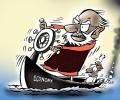
However, the Indian economy is expected to bounce back in 2021, the World Bank said.
In its latest report, the Bank has lowered its forecasts for developing countries, now eying growth at 4.8 per cent this year, down from its January estimate of 5.3 per cent.

Current President Robert Zoellick, who took office in July 2007, is schedule to retire in June.
World Bank on Wednesday warned that a prolonged war in Iraq may adversely affect India's GDP growth prospects in this fiscal.
The World Bank said on Wednesday rise in interest rates and oil prices is likely to slow down India's growth for the next few years.
India, along with other South Asian countries, is expected to sustain a growth of 6-6.3 per cent in the next two years, although global economic growth is slated to decline to 3.2 per cent, the World Bank said on Wednesday.
Leading non-banking financial company (NBFC) Shriram Finance on Friday said Japan-based MUFG Bank would invest Rs 39,618 crore, or $4.4 billion, to acquire a 20 per cent stake on a fully diluted basis through a preferential issue of equity shares.

The government on Thursday permitted RBI to invest $4.3 billion in special bonds of the World Bank, which would raise the agency's lending limit to India by a similar amount to $21.8 billion for infrastructure investment.

'India is quickly becoming the beating heart of modern chess, and its role as an economic power is more and more visible.'

Silver and gold prices declined sharply in the futures trade on Friday as traders booked profits at elevated levels after a record-breaking rally, tracking a bearish sentiment in global markets and a rebound in the US dollar.

Gujarat police arrest a woman allegedly involved in trafficking job aspirants to Myanmar and Thailand for cyber slavery. The accused lured people with promises of high-paying jobs and forced them to work for international cyber crime syndicates.

The recent correction suggests that while precious metals hedge geopolitical tension and inflation, they are not immune to sharp short-term corrections and profit-booking.

There are hopes of a turnaround in overall corporate earnings after six quarters of single digit growth.
The World Bank said on Monday hardening interest rates and a surge in oil prices worldwide will have a marginal impact on India's economy and the country would continue to witness high GDP growth.

The market rally was driven by strong buying in telecom, banking, realty, metal, FMCG and PSU counters.

French President Emmanuel Macron announced that India and France will collaborate to develop an artificial intelligence framework that combines innovation with responsibility and technology with humanity, addressing the need for inclusive digital tools amid rising geopolitical tensions.

A slowdown in India's growth rate, the bank said, has also affected the growth rate of South Asia. As a result, South Asia has fallen to second place after East Asia and the Pacific.
The World Bank on Friday approved a $80-million loan for the renovation and modernisation of old, polluting and inefficient coal-fired power plants in India, in a move that could help lower carbon emissions.

The pause gives the US time to breathe, to regroup, to move its expeditionary force into position without risk of interception along the way. It gives Iran nothing -- on the ground, attacks against its infrastructure continue apace. Prem Panicker in his must read daily blog on the Gulf War.
As per the latest government data, India's second quarter economic growth inched up to 4.8 per cent during second quarter (July-September) of 2013-14, well above 4.4 per cent in the first quarter (April-June).
The IFC Global Corporate Governance Forum has signed an agreement with the Reuters Foundation to encourage these journalists and help them report on governance more effectively, the two organisations said.
Buoyed by an increase in public investment and incentives to boost manufacturing, India's economy is expected to grow by 8.3 per cent in the fiscal year 2021-22, less than the previous projection early this year before the country was hit by the second wave of the COVID-19 pandemic, the World Bank has said in its latest report. World Bank chief economist for the South Asia Region Hans Timmer told PTI here that when one looks at the high frequency data, they see that as a result of the second wave of the COVID-19 pandemic, the recovery paused, and some indicate that the recovery actually declined briefly. "We project for this fiscal year 8.3 per cent (growth rate for Indian economy) that is less than we projected early in the year before the health crisis caused by the second wave. "Given the sharp contraction of the economy last year, it might not look like a lot, but in my view, that is actually very positive news, given the violent second wave and the severity of the health crisis," he said on Thursday.

Meera Shankar, Indian Ambassador to the United States, informed that India has convened a ministerial meeting in September in New Delhi to see how we can bring the Doha Round back on track and as a follow up to that meeting experts were expected to meet in October in Geneva.
RBI Governor Shaktikanta Das and Finance Secretary Subhash Chandra Garg are also expected to attend the meetings.

'For those in for the long haul, this is a God-given opportunity.' 'Your market is falling despite strong fundamentals, and such a clear roadmap has been announced.'

'After the Galwan clash, the rules of engagement changed with the army commanders allowed to use any means at their disposal as they deem fit for tactical operations.'
In a statement on Wednesday, World Bank said that its President Robert B Zoellick has announced that he would step down at the end of a five-year term in which a transformed Bank played an historic role during the global economic crisis, using record replenishments to provide more than $247 billion to help developing countries boost growth and overcome poverty.
'In India, there is this first generation migrant, say from a small village in UP. He didn't go to the Gulf to buy a big house but make the life of his family better.' 'He may have paid 1 lakh rupees to an agent to go to the Gulf. Imagine what will happen to him and his family if he has to come back. He and his family will become poor again.' 'He went to the Gulf to come out of poverty, but this war will make his family trapped in poverty once again.'
